16c95x Serial Port Driver

16c95x Serial Port Driver

Index

Home
Introduction
Configuring XPax
Using XPax
Main Screen
Manifest Screen
Diagram Screen
Aircraft Screen
Report Screen
Options Screen
Networked Configuration
Credits

Appendix
SimConnect Troubleshooting


Welcome To XPax - A Passenger Simulation Add-on for FSX and FS9!

16c95x Serial Port Driver May 2026

The next time you issue screen /dev/ttyS0 115200 , pause to appreciate the thousands of lines of kernel code that are, at that very moment, carefully policing the flow of bits through a 64-byte FIFO, ensuring that not a single character of your prompt is lost to the entropy of asynchronous transmission.

static const struct serial_rs485 serial_rs485_supported = .flags = SER_RS485_ENABLED ; static const struct uart_ops exar_ops = .tx_empty = exar_tx_empty, .set_mctrl = exar_set_mctrl, .start_tx = exar_start_tx, .stop_tx = exar_stop_tx, .handle_irq = exar_handle_irq, // The heart of the driver .startup = exar_startup, .shutdown = exar_shutdown, .set_termios = exar_set_termios, // Where baud, parity, flow are set ; 16c95x Serial Port Driver

To understand the driver is to understand a negotiation between a high-speed, interrupt-driven CPU and a comparatively slow, asynchronous, bit-shifting piece of silicon. Most developers cut their teeth on the 16550 UART—a 16-byte FIFO (First-In-First-Out) device that was revolutionary in the early 1990s. The 16c95x, however, is a different beast. It is a high-performance, multi-channel UART. Variants like the 16c954 or 16c955 offer two, four, or even eight independent serial ports on a single chip. The next time you issue screen /dev/ttyS0 115200

In the stratified world of computing, the graphic processing unit (GPU) and the central processor (CPU) receive the lion’s share of attention. Yet, the humble UART (Universal Asynchronous Receiver-Transmitter) remains the unsung workhorse of infrastructure. At the heart of many industrial, telecommunications, and legacy enterprise systems lies a specific breed of this technology: the 16c95x family. The software that brings it to life—the 16c95x Serial Port Driver —is a masterclass in managing latency, throughput, and hardware complexity. The 16c95x, however, is a different beast
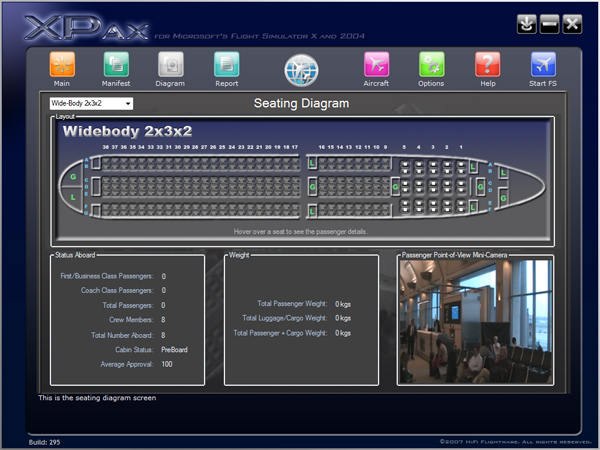
 
Passengers and their individual statistics including health and approval rating are constantly updated based on the performance of the flight. The entire flight process, from pre-boarding to deplaning, is simulated and supplemented by multimedia content including audio and video.
 
16c95x Serial Port Driver
Cabin attendants, Gate Attendants and Captain voice sets are included and fully customizable using the easy options screen. New voice sets can be recorded with a few clicks of the mouse. Video, provided in a “Passenger point-of-view” format is also fully customizable within the interface with bit of simple movie production.
 
XPax is designed to run along-side FS and automatically senses when certain phases of the flight take place, launching appropriate events, audio and video.
 
With XPax, everything you do is monitored closely and the passengers will react accordingly.  Using abrupt control movements, climbing or descending too fast, obtaining unusual attitudes, too many g-forces, aggressive taxi turns or a hard landing will all reduce passenger satisfaction and in extreme cases will cause injuries!
 
Many other features, as well as a comprehensive user guide and top-notch HiFi customer support are all included.
 
Features

The next time you issue screen /dev/ttyS0 115200 , pause to appreciate the thousands of lines of kernel code that are, at that very moment, carefully policing the flow of bits through a 64-byte FIFO, ensuring that not a single character of your prompt is lost to the entropy of asynchronous transmission.

static const struct serial_rs485 serial_rs485_supported = .flags = SER_RS485_ENABLED ; static const struct uart_ops exar_ops = .tx_empty = exar_tx_empty, .set_mctrl = exar_set_mctrl, .start_tx = exar_start_tx, .stop_tx = exar_stop_tx, .handle_irq = exar_handle_irq, // The heart of the driver .startup = exar_startup, .shutdown = exar_shutdown, .set_termios = exar_set_termios, // Where baud, parity, flow are set ;

To understand the driver is to understand a negotiation between a high-speed, interrupt-driven CPU and a comparatively slow, asynchronous, bit-shifting piece of silicon. Most developers cut their teeth on the 16550 UART—a 16-byte FIFO (First-In-First-Out) device that was revolutionary in the early 1990s. The 16c95x, however, is a different beast. It is a high-performance, multi-channel UART. Variants like the 16c954 or 16c955 offer two, four, or even eight independent serial ports on a single chip.

In the stratified world of computing, the graphic processing unit (GPU) and the central processor (CPU) receive the lion’s share of attention. Yet, the humble UART (Universal Asynchronous Receiver-Transmitter) remains the unsung workhorse of infrastructure. At the heart of many industrial, telecommunications, and legacy enterprise systems lies a specific breed of this technology: the 16c95x family. The software that brings it to life—the 16c95x Serial Port Driver —is a masterclass in managing latency, throughput, and hardware complexity.

Requirements:

  • Microsoft Flight Simulator X or Flight Simulator 2004

  • FSX Requires Service Pack 1 (which includes SP1 SimConnect), and FS9 requires FSUIPC v3.75 or later (available free from http://www.schiratti.com/dowson.html)

  • Windows XP or later (earlier operating systems not officially supported)

  • 1GB+ RAM

  • 500MB+ Free Hard Drive Space

  • .NET 2.0 (included with installation package)

  • Windows Media Player v11 or later

  • Internet Explorer v7 or later