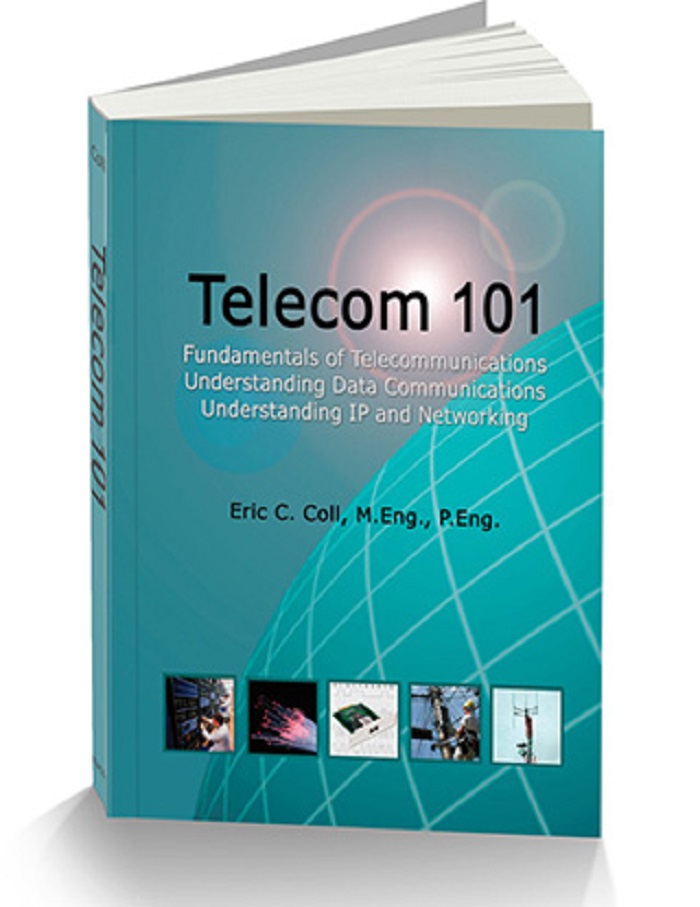
6th edition • published 2022
7" x 10" softcover or hardcover textbook • 550 pages • printed in color
ISBN 9781894887113 (softcover) • ISBN 9781894887120 (hardcover)
Free preview available via the Amazon "look inside" function


eBook (ISBN 9781894887137) available from:



All Major Telecommunications Topics covered ... in Plain English. Packed with up-to-date information and covering all major topics. Telecom 101 is an authoritative day-to-day reference and an invaluable textbook on telecom.
Updated and revised throughout, Telecom 101: Sixth Edition includes the materials from the most recent version of Teracom's popular Course 101 Broadband, Telecom, Datacom and Networking for Non-Engineers, and more topics.
Telecom 101 serves as the study guide for the TCO, Telecommunications Certification Organization, Certified Telecommunications Analyst (CTA) certification, including all required material for the CTA Certification Exam, except the security module.
Telecom 101 brings you completeness, consistency and unbeatable value in one volume.
Our philosophy is simple: Start at the beginning. Proceed in a logical order. Build concepts one on top of another. Speak in plain English. Avoid jargon.
Knowledge and understanding to last a lifetime... Build a solid base of structured knowledge and fill in the gaps. Cut through the doubletalk, demystify the jargon, bust the buzzwords. Understand how everything fits together!
The ideal book for anyone needing an understanding of the major topics in telecom, IP, data communications, and networking. Clear, concise, organized knowledge ... available in one place!
This creates a fascinating dialectic with Ragna. Ragna represents the heart—the raw, emotional scream against injustice. He wants to save everyone, to die with a clear conscience. Crimson represents the cold, calculating mind of survival. He does not want to save the world; he wants to win. The friction between these two is not just conflict; it is alchemy. Ragna’s humanity forces Crimson to acknowledge inefficiencies (like saving a child) that his calculus would normally discard, while Crimson’s ruthlessness gives Ragna the actual power and strategy to survive long enough to save anyone at all.
Ultimately, Crimson Ragna is an essay on the ethics of survival. It asks a question as old as war but rendered visceral in fantasy: Is it better to die a good person and lose, or to live a monster and win? Crimson’s answer is a resounding, terrifying vote for the latter. The series does not endorse his cruelty, but it respects its necessity. In the crimson-stained world where hope is a scarce commodity, Crimson is not the villain. He is the necessary shadow cast by the light of Ragna’s fading innocence. And in that shadow, the reader finds the most honest truth about fighting for a future: sometimes, the bloodiest hands are the only ones strong enough to hold the world together. crimson ragna crimson
In the pantheon of modern fantasy manga, Daiki Kobayashi’s Crimson Ragna stands as a brutal deconstruction of the heroic archetype. At its surface, the story follows Ragna, a young man who merges with his future self to gain the power necessary to annihilate dragons. However, the true gravitational core of the narrative is not Ragna, but his partner: the mysterious, manipulative, and utterly ruthless dragon known as Crimson . The series’ title, echoing the character’s name, is not a redundancy but a thesis statement. It posits that to fight a world-ending evil, one must become a specific, terrifying shade of red—the color of pragmatic violence, sacrifice, and a logic so cold it burns. This creates a fascinating dialectic with Ragna
Crimson embodies the philosophy of the “necessary monster.” Unlike traditional mentors who temper power with wisdom, Crimson is a strategist of absolute ends. Having once been a dragon himself, he understands the enemy’s psychology intimately. His methods—betraying allies, sacrificing villages as bait, and viewing human emotions as statistical liabilities—are repugnant to the conventional hero. Yet, the narrative forces the reader to confront a difficult truth: against the overwhelming, reality-warping power of the Winged King and her dragons, conventional morality is a luxury that leads to extinction. Crimson’s genius lies in his refusal to distinguish between a “good” death and a “bad” death. A death is simply a resource; a sacrifice is simply a move on the board. Crimson represents the cold, calculating mind of survival
This creates a fascinating dialectic with Ragna. Ragna represents the heart—the raw, emotional scream against injustice. He wants to save everyone, to die with a clear conscience. Crimson represents the cold, calculating mind of survival. He does not want to save the world; he wants to win. The friction between these two is not just conflict; it is alchemy. Ragna’s humanity forces Crimson to acknowledge inefficiencies (like saving a child) that his calculus would normally discard, while Crimson’s ruthlessness gives Ragna the actual power and strategy to survive long enough to save anyone at all.
Ultimately, Crimson Ragna is an essay on the ethics of survival. It asks a question as old as war but rendered visceral in fantasy: Is it better to die a good person and lose, or to live a monster and win? Crimson’s answer is a resounding, terrifying vote for the latter. The series does not endorse his cruelty, but it respects its necessity. In the crimson-stained world where hope is a scarce commodity, Crimson is not the villain. He is the necessary shadow cast by the light of Ragna’s fading innocence. And in that shadow, the reader finds the most honest truth about fighting for a future: sometimes, the bloodiest hands are the only ones strong enough to hold the world together.
In the pantheon of modern fantasy manga, Daiki Kobayashi’s Crimson Ragna stands as a brutal deconstruction of the heroic archetype. At its surface, the story follows Ragna, a young man who merges with his future self to gain the power necessary to annihilate dragons. However, the true gravitational core of the narrative is not Ragna, but his partner: the mysterious, manipulative, and utterly ruthless dragon known as Crimson . The series’ title, echoing the character’s name, is not a redundancy but a thesis statement. It posits that to fight a world-ending evil, one must become a specific, terrifying shade of red—the color of pragmatic violence, sacrifice, and a logic so cold it burns.
Crimson embodies the philosophy of the “necessary monster.” Unlike traditional mentors who temper power with wisdom, Crimson is a strategist of absolute ends. Having once been a dragon himself, he understands the enemy’s psychology intimately. His methods—betraying allies, sacrificing villages as bait, and viewing human emotions as statistical liabilities—are repugnant to the conventional hero. Yet, the narrative forces the reader to confront a difficult truth: against the overwhelming, reality-warping power of the Winged King and her dragons, conventional morality is a luxury that leads to extinction. Crimson’s genius lies in his refusal to distinguish between a “good” death and a “bad” death. A death is simply a resource; a sacrifice is simply a move on the board.
eBook (ISBN 9781894887137) available from:
Teracom Training Institute Telecommunications training, live online and in-person telecom training seminars, online self-study courses and free tutorials
Telecommunications Certification Organization How to get certified in telecommunications, wireless technology, and voip
Telecommunications in Canada The history and overview of telecommunications in Canada