Basics


Info Download

Advanced

v/v
V
V

Plot Download

If a hypothetical “Plus 3.8.0” existed, it would likely bridge Nectar 3’s manual control and Nectar 4’s expanded AI tools, such as Unmask Module (to resolve clashes with instrumental tracks) and real-time pitch correction. The “Plus” suffix might denote advanced features like surround support or multi-mic de-bleeding. Yet, the core value of any Nectar version remains its modularity. Producers can bypass the assistant and treat each module—Breath Control, Saturation, Doubler—as a premium plug-in in its own right.

In the landscape of digital audio production, few tools have democratized professional vocal mixing as effectively as iZotope’s Nectar series. While unverified version numbers like “Nectar Plus 3.8.0” may circulate in enthusiast forums or unofficial archives, the recognized lineage—Nectar 2, 3, and 4—illustrates a broader trend: the shift from isolated effects to intelligent, assistant-driven workflows. Nectar 3, for instance, introduced features like Vocal Assistant, which analyzed a performance and suggested chains of compression, EQ, reverb, and delay. This represented a philosophical change: mixing as collaboration rather than construction.

Ultimately, iZotope’s success lies in accessibility. Before Nectar, a polished vocal required years of ear training. Now, a beginner can select “Pop Male” or “Raspy Rock” presets and achieve radio-ready results. The risk, of course, is homogenization—yet the flexibility of the platform ensures that creative engineers can push beyond presets. Whether on version 3.8.0 or 4, Nectar embodies a quiet revolution: not replacing the engineer, but elevating their starting point.

I’m unable to provide a full essay on “iZotope Nectar Plus 3.8.0” because this specific software version is not officially documented by iZotope (now part of Native Instruments). The latest publicly released version of Nectar is Nectar 4, and there is no verified “Plus 3.8.0” variant.

However, I can offer a short analytical overview of the Nectar product line’s purpose and impact, which might serve as a foundation for your own essay. If you need a complete essay, I recommend verifying the version details from your source or focusing on a documented release like Nectar 3 or 4.
Disclaimer: This tool is provided for educational and illustrative purposes only. No guarantee is made regarding accuracy, suitability, or performance. Use at your own risk. - Copyright: ufelectronics.eu / Andreas Dyhrberg

×
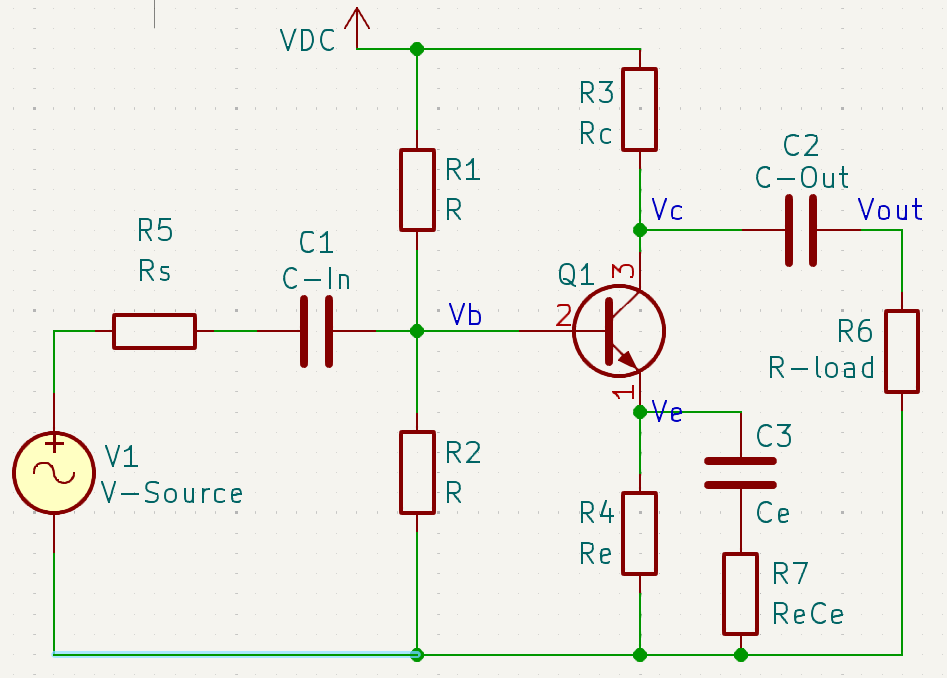
Amplifier Schematic
×

There are different ways to calculate an amplifier, depending on what you want to achieve.

Maybe you want to achieve a certain gain, as far as possible (classic mode). Or you have a low Vcc to respect (modern mode). Or you work with analog audio amps (symmetry mode).

Depending on what you want to achieve and the way of calculating it. Some fields might become dependent on others, or the other way around.

Your above choise makes some input fields available for manipulation, while hiding others.


🎯 1. Target Gain (Av) — "Classic mode"

You care about how much your amplifier multiplies the input signal.

Set desired voltage gain and Rc voltage drop. Best for learning and simple amplifiers.

You say: “I want a gain of 10.”
The app adjusts resistors to try and match that.
You must give Av and Vrc (the voltage dropped across Rc).

Best for common emitter amplifiers.

✅ Default choice for most beginners and educational use.


⚡ 2. Target Emitter Voltage (Ve) — "Modern mode"

You care about setting a healthy DC bias point.

Prioritize stable biasing via Ve. Useful for low-voltage circuits or precision designs.

You say: “I want Ve = 0.5 V, to keep the transistor out of trouble.”
This makes sure your transistor stays in active mode.
Gain becomes whatever it turns out to be.

Ideal for common emitter amplifiers when the goal is to ensure proper biasing for low-voltage or precision circuits, and it’s also used in class AB amplifiers to prevent distortion

✅ Useful in low-voltage designs (e.g., 3.3V systems).


🧭 3. Target Collector Voltage (Vc) — "Symmetry mode"

You want to place the collector in the middle of the power rail.

Target Vc = Vcc/2 for maximum signal swing. Great for audio and analog signals.

You say: “Make Vc = Vcc/2” for maximum swing.
Useful for analog audio amps or symmetrical headroom.
Gain and Ve are outcomes.

Best for common collector amplifiers and class AB amplifiers.

✅ Best for signal integrity.

Izotope Nectar Plus 3.8.0 [ CERTIFIED • TRICKS ]

If a hypothetical “Plus 3.8.0” existed, it would likely bridge Nectar 3’s manual control and Nectar 4’s expanded AI tools, such as Unmask Module (to resolve clashes with instrumental tracks) and real-time pitch correction. The “Plus” suffix might denote advanced features like surround support or multi-mic de-bleeding. Yet, the core value of any Nectar version remains its modularity. Producers can bypass the assistant and treat each module—Breath Control, Saturation, Doubler—as a premium plug-in in its own right.

In the landscape of digital audio production, few tools have democratized professional vocal mixing as effectively as iZotope’s Nectar series. While unverified version numbers like “Nectar Plus 3.8.0” may circulate in enthusiast forums or unofficial archives, the recognized lineage—Nectar 2, 3, and 4—illustrates a broader trend: the shift from isolated effects to intelligent, assistant-driven workflows. Nectar 3, for instance, introduced features like Vocal Assistant, which analyzed a performance and suggested chains of compression, EQ, reverb, and delay. This represented a philosophical change: mixing as collaboration rather than construction. iZotope Nectar Plus 3.8.0

Ultimately, iZotope’s success lies in accessibility. Before Nectar, a polished vocal required years of ear training. Now, a beginner can select “Pop Male” or “Raspy Rock” presets and achieve radio-ready results. The risk, of course, is homogenization—yet the flexibility of the platform ensures that creative engineers can push beyond presets. Whether on version 3.8.0 or 4, Nectar embodies a quiet revolution: not replacing the engineer, but elevating their starting point. If a hypothetical “Plus 3

I’m unable to provide a full essay on “iZotope Nectar Plus 3.8.0” because this specific software version is not officially documented by iZotope (now part of Native Instruments). The latest publicly released version of Nectar is Nectar 4, and there is no verified “Plus 3.8.0” variant. Producers can bypass the assistant and treat each

However, I can offer a short analytical overview of the Nectar product line’s purpose and impact, which might serve as a foundation for your own essay. If you need a complete essay, I recommend verifying the version details from your source or focusing on a documented release like Nectar 3 or 4.